




Insulin Syringe vs Insulin Pen: Cost, Dosing Accuracy and Waste
 Nov 11, 2026|
 View:7
Most people who inject insulin meet two very different delivery tools: a plain insulin syringe drawn from a vial, and a pen-style injector loaded with a cartridge. The two devices serve the same clinical goal, yet they differ in running cost, how the dose is set and measured, and what ends up in the sharps container. This guide compares both on those three practical axes.
Key Takeaways
An insulin syringe is a sterile, single-use device filled by the end user from an insulin vial, covered by ISO 8537; an insulin pen is a needle-based injection system covered by ISO 11608.
Vial-and-syringe regimens generally carry the lowest cost per dose because nothing beyond the syringe itself is purchased; pens shift cost toward the device and its cartridges.
Pens set the dose by dialling; syringes set it by drawing to a graduation mark, so accuracy depends on matching the syringe scale, such as U-40 or U-100, to the insulin concentration.
Regulatory agencies require both devices to be single-patient items: used syringes are discarded after one injection, and pen bodies must not be shared between patients even with a fresh needle.
What an Insulin Syringe and an Insulin Pen Are
Both devices exist to place a measured dose of insulin under the skin, usually subcutaneously. The difference is where the measurement happens: a syringe measures the dose by pulling liquid from a vial into a graduated barrel, while a pen measures it mechanically inside the device. Understanding that single difference explains most of the cost, accuracy and waste contrasts discussed below.
How an Insulin Syringe Works
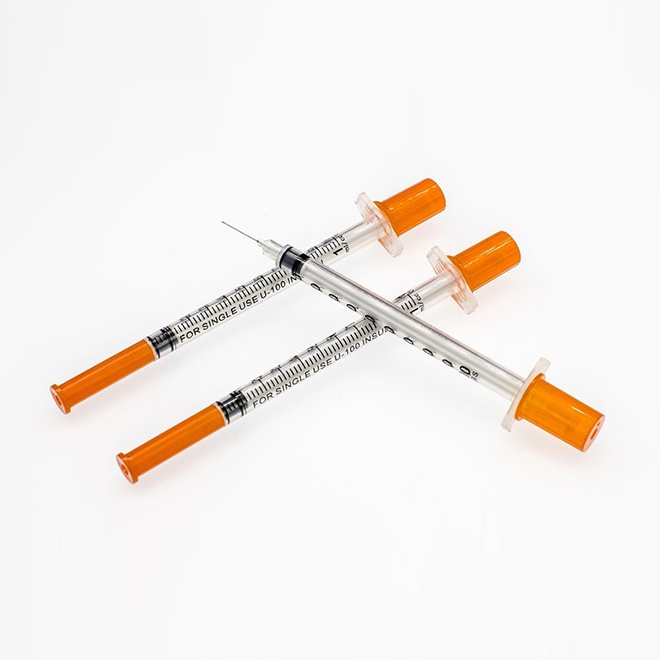
An insulin syringe combines a small barrel, a plunger, an integrated or detachable needle and, in fixed-needle designs, a protective cap. The user draws insulin from a multi-dose vial up to a graduation mark, then injects immediately. International standard ISO 8537 specifies requirements and test methods for sterile single-use syringes, with or without needle, intended solely for insulin injection and filled by the end user; the standard covers syringes used with different insulin concentrations and states that the devices are intended for injection soon after filling rather than for storing insulin. Manufacturer listings for this device class typically span 0.3 ml to 1 ml with U-40 and U-100 graduation scales; the published insulin syringe catalogue lists fixed-needle models in that size band, built with a medical-grade polypropylene barrel, a SUS304 stainless steel cannula and a latex or latex-free rubber plunger gasket, sterilised with ethylene oxide or gamma radiation.
Construction details matter clinically as well as commercially. Because the plunger seal and barrel contact the medicine directly, materials are stated in supplier documentation: the manufacturer names Borouge, SK, Lotte, FPC, SINOPEC or CNPC as polypropylene sources and Sabic for the polyethylene cap. For readers who want the wider context of general-purpose device construction, the factory also publishes guides on how a disposable syringe is constructed and functions.
How an Insulin Pen Works
An insulin pen is a pen-shaped injector that holds insulin in a replaceable cartridge or arrives prefilled by the pharmaceutical manufacturer. The user dials the dose, often in one-unit steps confirmed by an audible or visual click, attaches a disposable pen needle, and injects. ISO 11608-1 specifies requirements and test methods for needle-based injection systems intended for single-patient use that deliver discrete bolus volumes through needles or soft cannulas, incorporating prefilled or user-filled containers. The pen body is used repeatedly by one patient; only the needle is replaced per injection.
Cost: Consumables Versus Device Hardware
Cost comparisons between the two routes generally follow the hardware split. A vial-and-syringe regimen buys only disposable consumables: syringes are produced in very large volumes and, in published trade listings, sit at the low end of injection-device pricing, so the per-dose cost of the delivery device itself is usually the lowest available. The trade-off is that each injection consumes one entire syringe, and insulin remaining in a vial must be used within the in-use period printed on the medicine label.
Pens concentrate value differently. The device body, whether reusable with cartridges or fully disposable prefilled, carries a development and manufacturing cost that is reflected in the price of the insulin presentation, so the delivery cost per dose tends to be higher than a plain syringe. What purchasers are buying for that difference is dosing convenience and portability rather than a lower consumable price. For procurement teams comparing suppliers, the syringe side of this equation is where bulk pricing moves fastest, which is one reason distributors request quotations directly from device manufacturers rather than from pharmacy supply chains.
Dosing Accuracy: Graduation Marks, Dials and Dead Space
Accuracy with an Insulin Syringe
Accuracy with a syringe depends on three things a user controls: choosing the graduation scale that matches the insulin concentration, reading the meniscus at the correct mark, and holding the vial and barrel at eye level while filling. Insulin comes in different concentrations, commonly U-40 and U-100, and drawing U-100 insulin into a U-40 scale device, or the reverse, produces a dosing error. Precision also improves with fine graduations: 0.3 ml and 0.5 ml devices carry finer mark spacing than 1 ml barrels, which is why small paediatric or low-dose volumes favour the smallest suitable size.
Dead space is the second accuracy factor. A small volume of insulin remains in the needle hub and at the plunger tip after an injection; low dead-space designs reduce this retained volume, which matters both for dose precision and for avoiding wasted medicine over a multi-dose vial. Fixed-needle insulin syringe designs, as listed in manufacturer catalogues, integrate the cannula into the barrel assembly to limit such retained volume.
Accuracy with an Insulin Pen
A pen moves the measuring job into the device, so the user dials rather than draws. Dialled increments, typically one unit, remove reading errors such as parallax at a graduation mark, and the mechanism delivers a set stroke length. The accuracy of the dose then rests on the device mechanism and its cartridge rather than on user technique at the vial, which is why regulatory standards for needle-based injection systems place detailed requirements on delivered volume and dose-setting behaviour.
Compare Devices with Real Specifications
Buyers evaluating delivery devices can review published technical parameters, request quotations and download supporting documentation from the manufacturer.
Waste: What Each Regimen Discards
Every injection produces sharps waste, but the two regimens differ in volume and in what else is thrown away. With a syringe, one plastic barrel and cannula per injection goes into the sharps container, and any insulin left in a vial at the end of its in-use period is discarded as medicine waste. With a pen, one pen needle per injection plus an empty cartridge or an entire prefilled body eventually joins the waste stream; a reusable pen spreads its body waste over many injections, while prefilled pens dispose of a full device each cycle.
Sharps handling rules are identical for both: used devices go into an approved rigid container, following the disposal directions on the medicine and device labelling. Regulatory guidance from the United States further requires multi-dose diabetes pen devices to carry label warnings that restrict each pen to a single patient, as summarised in a patient-safety review of the 2015 FDA safety communication, because blood can enter the cartridge after use and transmission of blood-borne infections has been documented as a risk when pens are shared even with needle changes.
The table below summarises the comparison from published standards and regulatory guidance.
| Feature | Insulin Syringe | Insulin Pen |
|---|---|---|
| Governing standard | ISO 8537, sterile single-use syringes for insulin | ISO 11608-1, needle-based injection systems |
| Dose setting | Drawing from a vial to a graduation mark | Dialling a set number of units |
| Insulin supply | Multi-dose vial, filled by the end user | Cartridge or prefilled by the manufacturer |
| Consumed per injection | One syringe | One pen needle |
| Device sharing rule | Single use, discarded after one injection | Single patient only, must not be shared even with a new needle |
| Published size range (manufacturer listing) | 0.3 ml to 1 ml, U-40 and U-100 scales | Set by the medicine presentation, not the device maker |
Two representative fixed-needle models from the published range illustrate the product class described above.
Disposable Insulin Syringe 1ml
Fixed-needle 1 ml model with a medical-grade polypropylene barrel, SUS304 cannula and EO or gamma sterilisation, per the published product page.
View Product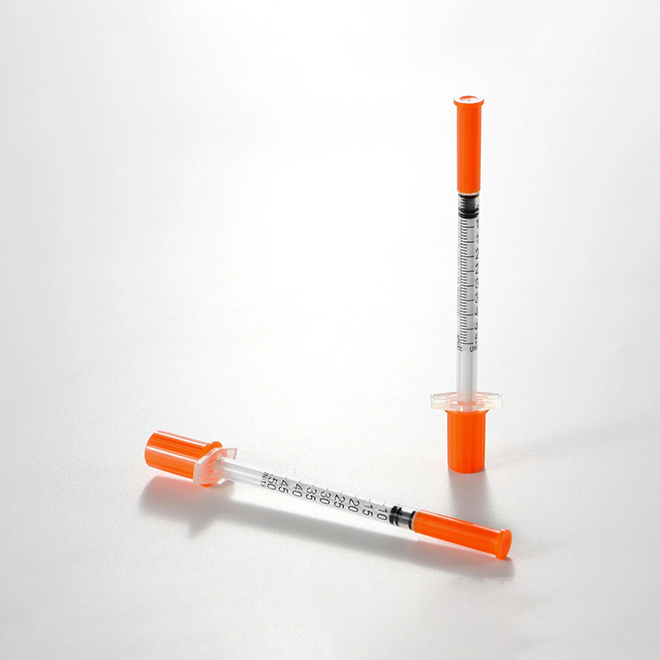
0.5ml 1ml 2ml Sterile Medical Insulin Syringe
Multi-size sterile single-use model published with U-40 and U-100 graduations, latex or latex-free plunger gasket and blister peel pouch packaging.
View ProductDiscuss Supply Directly with the Manufacturer
Holinx publishes specifications, packaging formats and OEM or ODM options for its single-use injection device lines, and accepts inquiries for bulk orders.
Conclusion
The choice between a syringe and a pen is rarely about which device is objectively better; it is about matching cost structure, dosing technique and waste profile to the setting. Syringes win on per-dose consumable cost and remain the standard for vial-based regimens, provided the graduation scale matches the insulin concentration. Pens reduce user-side measuring tasks and concentrate accuracy in the device mechanism, at a higher price per dose and with stricter single-patient sharing rules. Either way, the device must be sterile, single-use where the standard says so, and sourced from a manufacturer whose published specifications can be verified.
For readers comparing insulin syringe manufacturers, Holinx provides published specifications, technical documentation and direct inquiry channels for further evaluation.
FAQ
Can an insulin syringe be used with any insulin concentration?
The graduation scale must match the concentration. U-40 insulin is drawn with a U-40 scale and U-100 insulin with a U-100 scale; mixing them causes a proportional dosing error. ISO 8537 covers syringes used with different insulin concentrations precisely because both scales exist.
Why must an insulin pen not be shared between patients even with a new needle?
Blood can enter the cartridge or reservoir after an injection, so residual contamination can remain inside the pen body even when the needle is replaced. Regulatory agencies require multi-dose diabetes pens to carry single-patient-use label warnings for this reason.
Which option costs less in the long run?
For delivery hardware alone, vial-and-syringe regimens are generally the lowest-cost route because each dose needs only one disposable syringe. Pens cost more per dose but are chosen for dosing convenience. Total cost also depends on medicine presentation, wastage within the in-use period and local pricing, so a general ranking cannot replace a per-setting calculation.
What sizes do published insulin syringe listings cover?
Published manufacturer listings span 0.3 ml to 1 ml graduated markings, with additional multi-size models at 0.5 ml, 1 ml and 2 ml, in U-40 and U-100 versions, with fixed-needle designs and EO gas or gamma sterilisation.
How should used syringes and pen needles be discarded?
Into an approved rigid sharps container that needles cannot pierce, kept closed and out of reach of children, following the disposal directions printed on the medicine and device labelling.
References and Notes
ISO 8537:2016, sterile single-use syringes, with or without needle, for insulin — scope, end-user filling and immediate-use wording (iso.org, accessed 2026-11-16)
ISO 11608-1:2022, needle-based injection systems for medical use, Part 1 — pen-class device scope and single-patient use (iso.org, accessed 2026-11-16)
AHRQ PSNet summary of the 2015 FDA safety communication on multi-dose diabetes pen devices — single-patient label warnings and sharing risk (ahrq.gov, accessed 2026-11-16)
FDA consumer guidance on insulin devices — device types, sharing prohibition and sharps disposal advice (fda.gov, accessed 2026-11-16)
Data notes: device construction, size ranges, materials, sterilisation and packaging figures are manufacturer-stated values taken from the Holinx insulin syringe category and product pages (accessed 2026-11-16); cost statements are qualitative and industry-general, with no price figures asserted.